How to estimate corn yield by counting kernels
Start with four short stretches of row. Count the kernels on the ears you collect, then use row spacing and kernel weight to turn those counts into a preharvest corn yield estimate.

Sample the row before you count the kernels
A full ear can look promising on its own. The estimate changes when you include the gaps between plants and the ears with poor fill. Pick sites that represent the field conditions you want to forecast. If strong and weak zones cover visibly different areas, sample them separately and weight their estimates by area.
Mark a measured length of productive row at each site. Count the kernels on the harvestable ears from that stretch, keeping its full measured length in the denominator. Label the photos with the section ID so you can match every count to the row it represents. Sample late enough for the kernels you count to be reasonably established.
For this worked example, the North Field has four sampled sections of 3 m. We use three groups of ears per section, giving 12 measurements altogether. The counts below are demonstration data.
| Row section | Length sampled | Kernels counted |
|---|---|---|
| A | 3 m | 6,000 |
| B | 3 m | 5,850 |
| C | 3 m | 6,200 |
| D | 3 m | 5,950 |
| Total | 12 m | 24,000 |
Calculate kernels per hectare
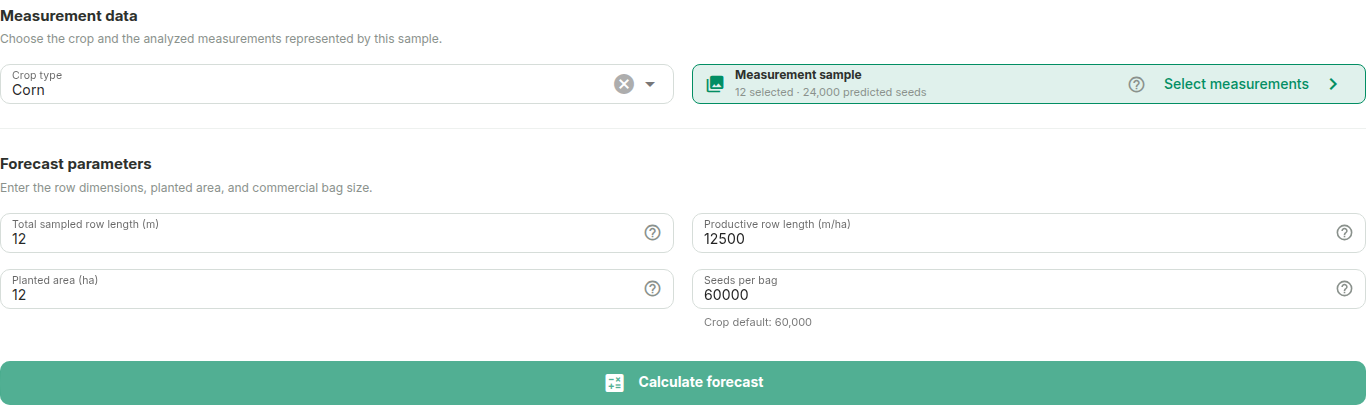
Start by dividing the total kernel count by the total length sampled. All four stretches in this example have the same length, so pooling them gives the same result as averaging the four kernel densities.
Next, calculate the length of productive row in one hectare. If every row contributes and spacing is uniform, divide 10,000 m² by the row spacing. This field has 0.80 m spacing, giving 12,500 m of row per hectare. In seed production, use the actual length of the rows you intend to harvest. Male rows, gaps and areas outside the planted boundary can change which length applies.
- 24,000 kernels ÷ 12 m = 2,000 kernels/m
- 10,000 m² ÷ 0.80 m = 12,500 m of row/ha
- 2,000 kernels/m × 12,500 m/ha = 25,000,000 kernels/ha
In the SeedMetrics web dashboard, open Analytics in Field mode. Under Seed bag forecast, select the crop and all analyzed measurements for your sample. Enter the sampled row length, productive row length per hectare, planted area and seeds per bag.
Turn a kernel count into weight or seed bags
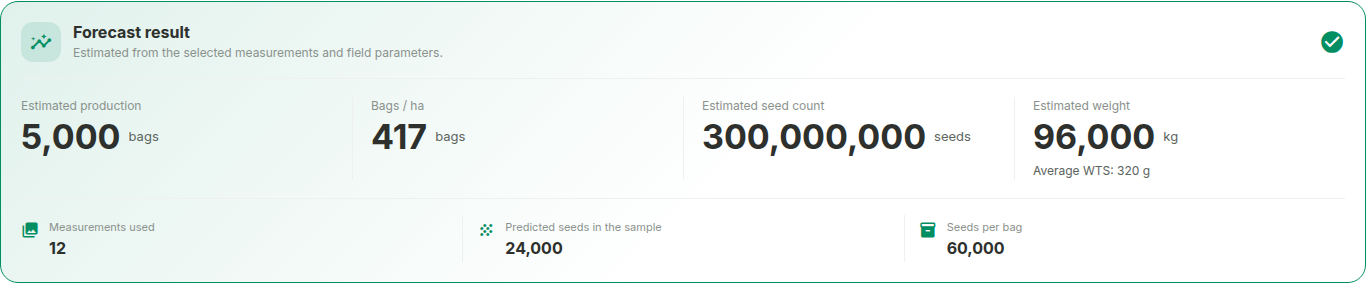
If your thousand-kernel weight is 320 g, the 25 million kernels per hectare imply 8,000 kg/ha, or 8 t/ha, on the same moisture basis as the weight measurement. Across 12 planted hectares, that is about 96,000 kg. In SeedMetrics, the weight estimate uses the sample weights associated with the selected measurements when those weights are available.
25,000,000 kernels/ha × 320 g ÷ 1,000,000 = 8,000 kg/ha
For seed production, divide the estimated kernels by the number of seeds per commercial bag. At 60,000 seeds per bag, this example gives approximately 417 seed bags/ha and 5,000 seed bags across the field. These are production equivalents before any grading, cleaning or other losses.
If your report uses 60 kg grain sacks, divide the weight per hectare by 60. Here that gives about 133.3 sacks/ha. The screenshot reports bags by seed count, so use the weight result for the 60 kg conversion.
Check the assumptions before sharing the number
At the same estimated kernel count, changing the thousand-kernel weight from 300 g to 340 g moves this forecast from 7.5 to 8.5 t/ha. That gives a useful sensitivity range while the grain is still filling. Keep the assumed weight, moisture basis and sampling date alongside the result.
When harvest figures are available, compare them with the forecast on the same area and moisture basis. If a particular zone repeatedly comes in low, use that difference to improve your next sampling plan.
- Keep the row length and kernel count paired for every sampled section.
- Check that productive row length represents one hectare and the rows you will harvest.
- Record the weight basis and the precise meaning of a bag in your report.
Further reading
Start with a corn ear from your next sample
See how to photograph an ear and count its kernels with SeedMetrics. Then explore how field teams connect those measurements to a forecast.