How to calculate thousand-seed weight
Weigh a counted group of seeds, then scale that mass to 1,000 seeds. Here’s a worked corn example you can reproduce with a tray, a balance and a calculator.
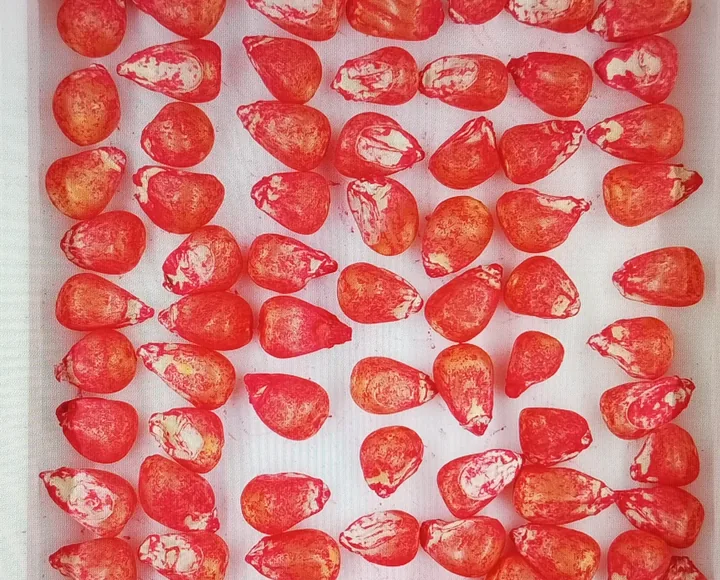
Count and weigh the same working seeds
Start with a representative working portion and give it an ID. Set the empty container on the balance and tare it. Add the seeds, let the reading settle and record the net mass in grams. Keep those exact seeds together until the count is complete. If a seed falls out or a piece is removed after weighing, reconcile the sample and weigh it again.
Count by hand, with a mechanical counter or from a photo. If two photos are needed, track each tray under the same sample ID. An error in either the count or the mass carries through to the final result.
Calculate the mass per 1,000 seeds
Divide the sample mass in grams by the seed count to get the average mass of one seed. Multiply by 1,000 to express that average as thousand-seed weight (TSW). In this example, 240 corn seeds weigh 76.8 g.
- TSW (g) = sample mass (g) ÷ seed count × 1,000
- 76.8 g ÷ 240 × 1,000 = 320 g per 1,000 seeds
If you record several portions, calculate each result first. In this demonstration, a second portion of 250 seeds weighs 80.25 g and gives 321 g per 1,000 seeds. Compare the two results before combining them. If a difference exceeds your lab’s review limit, check the original counts, balance readings and units. For a simple combined estimate across these unequal portions, use the combined mass and count. Formal methods may prescribe different replicate sizes, tolerances, rounding and reporting.
- (76.8 g + 80.25 g) ÷ (240 + 250) × 1,000 ≈ 320.5 g per 1,000 seeds
Convert the result to seeds per kilogram
Using the first portion’s result, 1,000 seeds weigh 0.320 kg. Divide 1,000 by 0.320 to get about 3,125 seeds per kilogram. If a bag contains 20 kg of seed with the same thousand-seed weight, that translates to about 62,500 seeds. Treat it as a planning estimate. Moisture, coatings and seed size can change the mass per seed.
- Seeds/kg = 1,000,000 ÷ TSW (g)
- 1,000,000 ÷ 320 = 3,125 seeds/kg
- 3,125 × 20 kg = 62,500 seeds
Save the inputs with the result
Keep the sample ID, net mass, count and units alongside the result. Record the moisture or coating condition where it matters to your comparison. For reporting under an official method, use the prescribed working portion and review rules. In Brazil, MAPA’s Regras para Análise de Sementes gives the official procedure for seed weight.
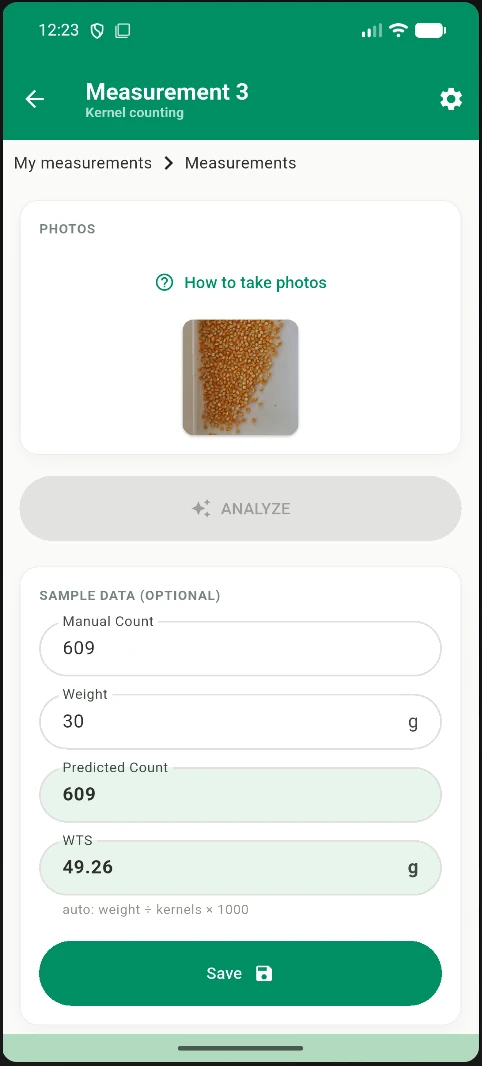
In SeedMetrics, confirm the detected count and enter the net sample mass from your balance. The app calculates thousand-seed weight from those two inputs. The photo provides the count and the balance provides the mass.
Further reading
Calculate thousand-seed weight from a counted sample
Take a photo of the seeds you weighed and keep the measured mass and verified count together in the sample record.